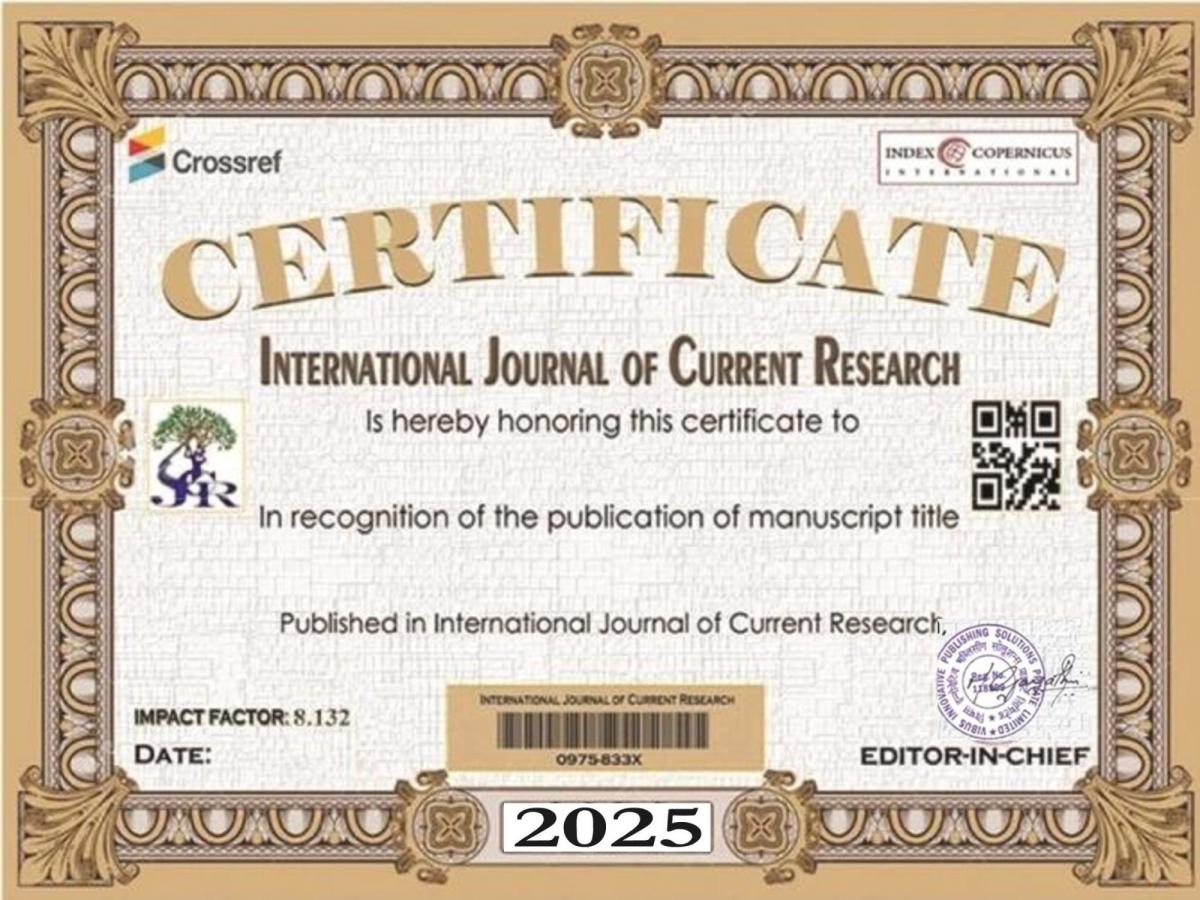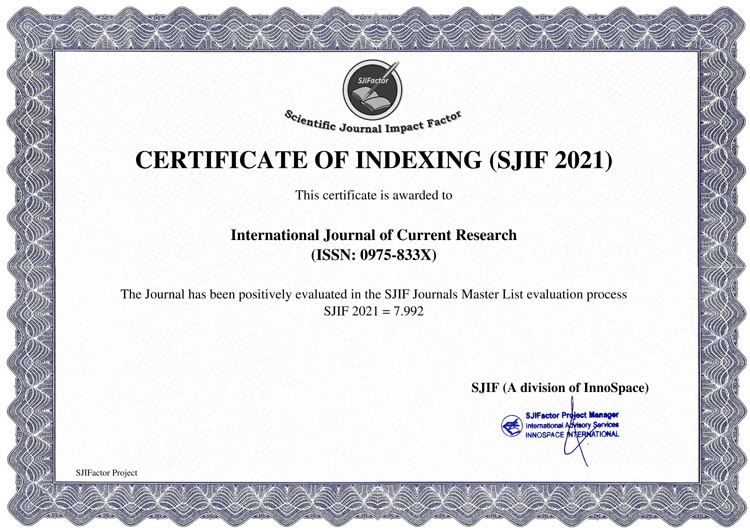
CERTIFICATE

IMPACT FACTOR 2021

Subject Area

  • Life Sciences / Biology
  • Architecture / Building Management
  • Asian Studies
  • Business & Management
  • Chemistry
  • Computer Science
  • Economics & Finance
  • Engineering / Acoustics
  • Environmental Science
  • Agricultural Sciences
  • Pharmaceutical Sciences
  • General Sciences
  • Materials Science
  • Mathematics
  • Medicine
  • Nanotechnology & Nanoscience
  • Nonlinear Science
  • Chaos & Dynamical Systems
  • Physics
  • Social Sciences & Humanities

Why Us? >>

  • Open Access
  • Peer Reviewed
  • Rapid Publication
  • Life time hosting
  • Free promotion service
  • Free indexing service
  • More citations
  • Search engine friendly

L’utilisation des feuilles de moringa et les larves de mouches soldats noires comme sources alternatives de protéine chez les poulets brahma améliore la croissance et rentabilité économique

Author: 
Azoutane Julien1, Mube Kuietche Hervé, Amang B. Moise, Nyembo Kondo Camile, Francois Djitie, Defang F. Henry and Tendonkeng Fernand
Subject Area: 
Life Sciences
Abstract: 

The escalating costs of raw materials in the national market, coupled with the intensifying competition between humans and animals for conventional protein sources, have prompted a search for effective low cost and environmentally sustainable alternatives for livestock farming. This study is focused on the incorporation of Moringa leaf meal (FM) and black soldier fly larvae (FMSN) in Brahma chicken’s feed. During the experiment, 54 Brahma hens of three weeks were hazardly splited into three experimental groups of 18 hens each. Then, each group was still grouped into three replicates of six (6) hens. The experimental rations comprised a basal ration (FMMSN0), without any complement (FM or FMSN); the FMMSN10 ration (5% FM and 5% MSN); and the FMMSN30 ration (15% FM and 15% MSN). During 16 weeks, data were collected on growth characteristics of chickens. At 19th week of age, four animals from each group were sacrified for carcass yield determination. Then, the economic value of rations was also evaluated. Collected data’s were submitted to one-factor analysis of variance using the general linear model. The results showed that, FMMSN10 ration exhibited the highest growth performance, and the lowest feed conversion ratio (p<0.05) among all the experimental groups. While, the inclusion of FM and MSN in the ration did not result in any discernible impact on the carcass yield of the chickens. Nevertheless, the lowest production cost was observed with the ration FMMSN10 per kilogram. At the end, it can conclude that the incorporate of 10% FM and MSN in the Brahma chickens ration is not harmful to animals or meat consumers; and obviously reduces the production cost.

PDF file: 

ONLINE PAYPAL PAYMENT

IJMCE RECOMMENDATION

Advantages of IJCR

  • Rapid Publishing
  • Professional publishing practices
  • Indexing in leading database
  • High level of citation
  • High Qualitiy reader base
  • High level author suport

Plagiarism Detection

IJCR is following an instant policy on rejection those received papers with plagiarism rate of more than 20%. So, All of authors and contributors must check their papers before submission to making assurance of following our anti-plagiarism policies.


EDITORIAL BOARD

MIEZAN Essou Koffi Benjamin
Côte d’Ivoire
Dr. Govindaiah Simuni
USA
Dr. Swamy KRM
India
Dr. Abdul Hannan A.M.S
Saudi Arabia.
Luai Farhan Zghair
Iraq
Hasan Ali Abed Al-Zu’bi
Jordanian
Fredrick OJIJA
Tanzanian
Firuza M. Tursunkhodjaeva
Uzbekistan
Faraz Ahmed Farooqi
Saudi Arabia
Eric Randy Reyes Politud
Philippines
Elsadig Gasoom FadelAlla Elbashir
Sudan
Eapen, Asha Sarah
United State
Dr.Arun Kumar A
India
Dr. Zafar Iqbal
Pakistan
Dr. SHAHERA S.PATEL
India
Dr. Ruchika Khanna
India
Dr. Recep TAS
Turkey
Dr. Rasha Ali Eldeeb
Egypt
Dr. Pralhad Kanhaiyalal Rahangdale
India
DR. PATRICK D. CERNA
Philippines
Dr. Nicolas Padilla- Raygoza
Mexico
Dr. Mustafa Y. G. Younis
Libiya
Dr. Muhammad shoaib Ahmedani
Saudi Arabia
DR. MUHAMMAD ISMAIL MOHMAND
United State
DR. MAHESH SHIVAJI CHAVAN
India
DR. M. ARUNA
India
Dr. Lim Gee Nee
Malaysia
Dr. Jatinder Pal Singh Chawla
India
DR. IRAM BOKHARI
Pakistan
Dr. FARHAT NAZ RAHMAN
Pakistan
Dr. Devendra kumar Gupta
India
Dr. ASHWANI KUMAR DUBEY
India
Dr. Ali Seidi
Iran
Dr. Achmad Choerudin
Indonesia
Dr Ashok Kumar Verma
India
Thi Mong Diep NGUYEN
France
Dr. Muhammad Akram
Pakistan
Dr. Imran Azad
Oman
Dr. Meenakshi Malik
India
Aseel Hadi Hamzah
Iraq
Anam Bhatti
Malaysia
Md. Amir Hossain
Bangladesh
Ahmet İPEKÇİ
Turkey
Mirzadi Gohari
Iran